
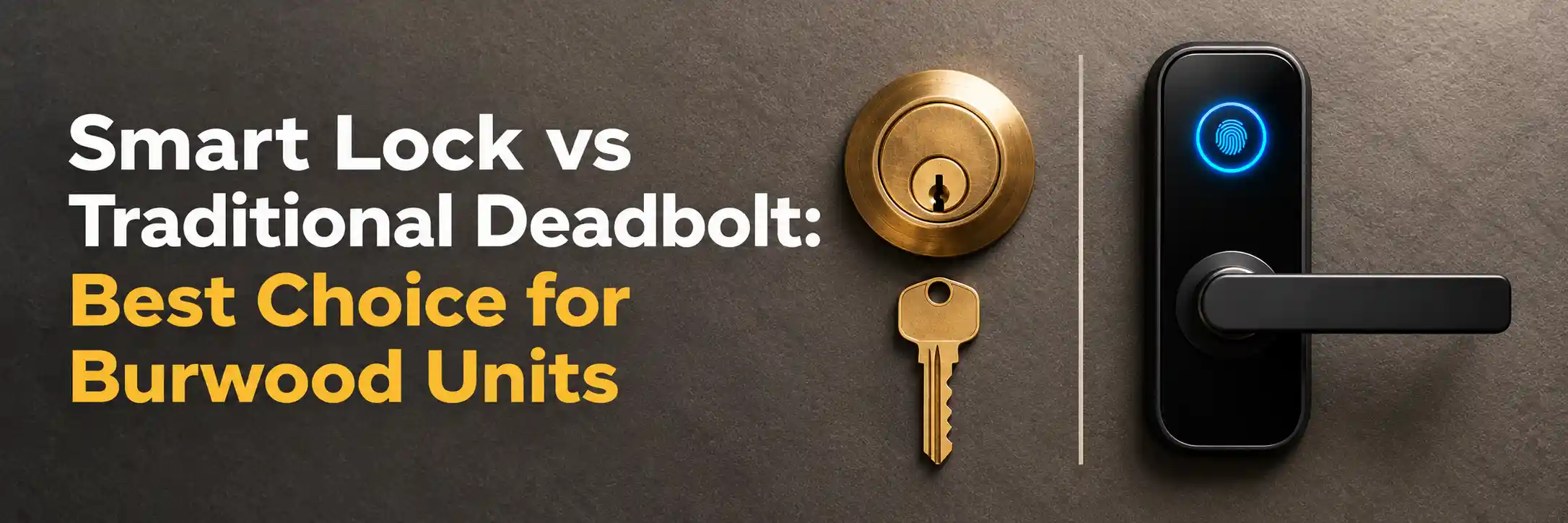
Burwood’s apartment market is one of the Inner West’s densest — the towers on Burwood Road and Shaftesbury Road, the managed complexes near the station, the Victorian-era unit blocks interspersed with modern high-rises. Smart lock vs deadbolt Burwood units residents consider is a genuine decision with specific local parameters. The strata governance that applies to most Burwood apartments, the building management systems already in place in newer complexes, and the wide range of door hardware across Burwood’s varied apartment stock all shape what’s actually feasible — and what makes practical sense for different household situations.
What Each Option Actually Does
A traditional deadbolt is a physical cylinder and bolt mechanism. The key turns the cylinder, the cylinder operates the bolt, the bolt engages the strike plate in the door frame.
Security depends on the cylinder’s resistance to picking, drilling, and bumping, and on the strike plate’s anchoring into the frame. No batteries, no app, no Wi-Fi dependency. It works when the power is out, when your phone is dead, and when the building’s internet is down.
A smart lock replaces or augments the cylinder with an electronic access mechanism — a keypad, a fingerprint reader, a Bluetooth or Wi-Fi module that communicates with a smartphone app, or some combination of these. Access can be granted via PIN, fingerprint, app, or physical key backup (which any serious smart lock includes). Remote management — issuing access codes, checking who’s entered, revoking credentials — is the feature set that most distinguishes smart locks from traditional hardware in practical use.
The Strata Question: First Check Before Any Purchase
Most Burwood apartments are in strata schemes. Most strata schemes have by-laws that govern modifications to lot property and common property.
Before any smart lock is purchased for a Burwood unit, the strata by-law check is mandatory — not optional, and not something to worry about after the hardware arrives.
What to establish from the strata manager before purchasing:
- Is the entry door defined as lot property or common property in the strata plan? If the door or its external face is common property — which it is in many schemes — visible hardware changes require owners corporation approval.
- Does the building maintain a physical master key system for emergency unit access? Many Burwood managed buildings have building manager emergency access via physical master key. A smart lock that removes the keyed cylinder would conflict with this requirement.
- Is the entry door fire-rated? Burwood’s newer apartment buildings have fire-rated entry doors. Hardware changes to fire-rated doors must be confirmed compatible with the door’s certification.
- Does the strata have an approved hardware list? Some buildings with unified access systems specify what unit entry hardware is permitted.
For renters in Burwood: a smart lock installation is a structural modification under the Residential Tenancies Act 2010 (NSW), requiring written landlord approval — in addition to any strata approval the landlord needs to obtain. This is a two-step process that takes time. Plan accordingly.
Pro Tip:
Call the strata manager before ordering any smart lock for a Burwood unit and ask three specific questions: ‘Is my unit entry door lot property or common property?’, ‘Does the building maintain a physical master key for unit emergency access?’, and ‘Is there an approved hardware list for unit entry modifications?’ These three answers take five minutes to get and prevent the situation where a smart lock is unboxed and turns out to conflict with one of these conditions.
When a Smart Lock Makes Clear Sense for a Burwood Unit
For the right Burwood apartment and the right household situation, a smart lock delivers sustained daily value:
High-turnover access needs. A Burwood apartment used as a rental investment, particularly one with regular tenancy changes, benefits significantly from smart lock management: outgoing tenant codes deactivated, incoming tenant codes issued, without physical key exchanges or locksmith visits between tenancies. For a Burwood landlord managing multiple properties, this operational efficiency compounds quickly.
Share households. Burwood’s apartment market attracts professional share households. A smart lock with individual PINs per resident eliminates the key management problem that accumulates in share arrangements — no key to lose, no housemate departure creating an unreturned key concern, no ‘how many copies exist?’ question at end of tenancy.
Frequent service provider access. A cleaner who comes fortnightly, a maintenance person with scheduled visits, a family member who needs occasional access — these access management scenarios are where smart locks provide clear, sustained benefit over physical key management. Time-limited PINs active only during scheduled windows eliminate the need for key issuance entirely.
The auto-lock anxiety. Burwood’s proximity to the CBD means many residents leave quickly for morning commutes. A smart lock with a reliable auto-lock function — ensuring the door is always locked a set time after closing — addresses the common ‘did I lock the door?’ anxiety specific to hurried urban apartment living.
When a Quality Deadbolt Is the Better Answer
Smart locks aren’t universally superior. A well-specified deadbolt consistently outperforms a smart lock in several Burwood-specific scenarios:
Victorian-era and older Burwood apartment buildings. The older unit blocks in Burwood’s housing mix often have doors with non-standard dimensions, older mortice lock configurations, or frame conditions that make standard smart lock installation complex or impossible without significant work.
For these properties, a high-security cylinder upgrade within the existing hardware is more practical and often more cost-effective than a smart lock installation.
Single-occupant stable households. A Burwood apartment occupied by one person with no access management needs beyond their own entry doesn’t generate the use case that justifies a smart lock’s cost and complexity.
A quality deadbolt with a restricted key blank provides excellent security without any of the maintenance overhead that electronic hardware introduces.
Budget-constrained security upgrade. A high-security cylinder with anti-pick, anti-drill, and anti-bump features, plus a reinforced strike plate, costs significantly less than a quality smart lock and produces a security improvement that’s measurable against specific attack vectors.
For Burwood renters or owners prioritising security over convenience, this is often the more effective investment.
“The smart lock vs deadbolt conversation in Burwood comes up constantly. Our answer is always the same: what problem are you actually trying to solve? If it’s key management across multiple people — smart lock, and let’s check the strata first. If it’s security concerns about the existing hardware — upgraded cylinder and strike plate, faster and often more relevant. If it’s both — there’s a sequence for that too.”
The Hybrid Approach: Best of Both
For Burwood apartments where both security improvement and access management are relevant, the sequence that produces the best outcome:
- Confirm strata compatibility and get written approval before purchasing anything
- Select a smart lock that includes a physical key cylinder backup — not an optional add-on, a core specification requirement
- Confirm the smart lock’s cylinder is upgradeable to a high-security restricted-key configuration — some smart lock cylinders accept standard blanks only, which limits key control
- Pair the smart lock installation with a reinforced strike plate anchored into structural framing — the smart lock controls access electronically; the strike plate determines forced-entry resistance
- Register the smart lock’s physical cylinder in the building’s master key system if the strata requires this — confirm before installation, not after
Warning:
Don’t install a smart lock in a Burwood apartment and remove the physical key cylinder entirely. A purely electronic entry — no keyed backup — creates a single point of failure: a flat battery, a software bug, or a connectivity issue at the wrong moment produces a lockout with no non-destructive solution. Every quality smart lock for a residential application should retain a physical key cylinder as a documented, working backup. If the product you’re considering doesn’t include this, consider a different product.
Compatibility: What to Check Before Buying
Smart lock compatibility for Burwood apartments depends on variables specific to each door:
- Door thickness — standard smart locks specify a door thickness range, typically 35–55mm. Burwood’s older apartment buildings may have doors outside this range.
- Existing lock type — cylindrical deadbolts can typically be replaced directly; mortice locks in older buildings require either a mortice-specific smart lock or a different approach.
- Door operation — a door that requires technique to close or latch won’t auto-lock reliably. Fix the door operation before installing a smart lock with auto-lock functionality.
- Wi-Fi or Bluetooth availability — smart locks requiring continuous app connectivity depend on reliable signal at the entry door. In Burwood’s concrete apartment buildings, signal quality at unit entry points varies.
Conclusion
Smart lock vs deadbolt Burwood units decision is shaped by the specific apartment, the strata scheme’s conditions, and the household’s actual access management needs. A smart lock is the right answer for households with multiple users, regular access management requirements, or remote management needs — provided the strata check passes and the door is compatible.
A quality deadbolt upgrade is the right answer for stable single-occupant households, older Burwood unit buildings with non-standard door configurations, and anyone whose priority is security improvement over access management convenience. Getting the strata check done before purchasing anything is the step that most consistently produces better outcomes for Burwood apartment owners.