
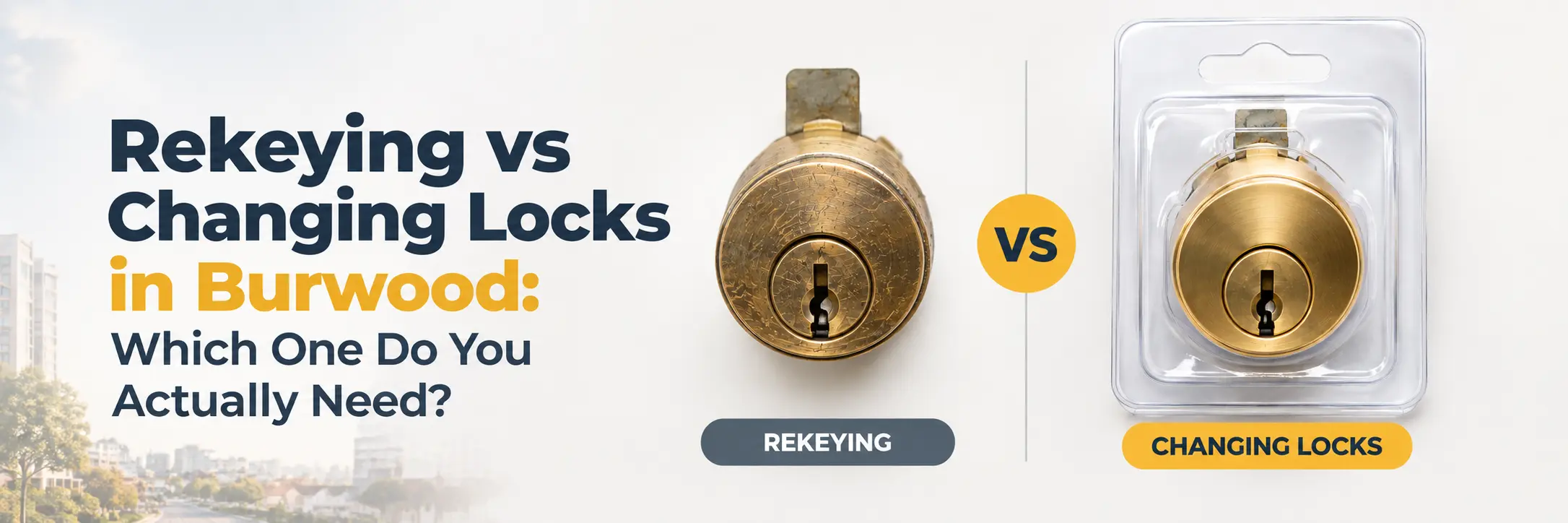
When something’s wrong with a lock — or when the key history feels uncertain — the instinct is to call a locksmith and ask to have the lock changed. In Burwood, as in most Sydney suburbs, this request is often the right outcome but sometimes the wrong solution for the actual problem. Rekeying vs changing locks Burwood residents should understand is a meaningful distinction that affects both what gets solved and what it costs.
Getting clear on which option addresses the specific situation produces a better outcome than defaulting to whichever sounds more thorough.
What Each Option Actually Does
Rekeying changes the internal pin configuration of an existing cylinder. The cylinder’s pins are re-set to a new combination that matches a newly cut key. Previous keys stop working. The external hardware — the cylinder body, the escutcheon plate, the deadbolt and strike plate — stays exactly as it is. Rekeying doesn’t replace anything physical outside the pin stacks inside the cylinder.
Changing the lock (or more precisely, replacing the cylinder or the entire lock mechanism) installs new hardware. A cylinder replacement keeps the existing lock case and replaces only the cylinder insert. A full lock replacement removes the entire mechanism — case, cylinder, deadbolt, and in some cases the strike plate — and installs new hardware throughout.
The practical distinction: rekeying changes who can operate the lock. Replacing changes what lock is operating. These are different problems with different solutions.
When Rekeying Is the Right Answer
Rekeying addresses the key history problem. If the lock itself is functioning correctly but the question is whose keys work in it, rekeying is the correct and most cost-effective solution:
- Moving into a Burwood property — whether buying or renting, the previous occupants’ key network is closed by a rekey. The lock’s physical condition doesn’t change; the key history does.
- Staff departure with a key not returned — in Burwood’s commercial properties, a staff member who leaves and keeps their key is a key control problem, not a hardware problem. Rekeying the cylinder closes the departed staff member’s access without touching the hardware.
- Lost key — a key that’s gone missing represents an unknown holder. Rekeying closes the exposure of the lost key without requiring any hardware assessment or replacement.
- Multiple tenancies in a rental property — a Burwood landlord who rekeys between tenancies rather than replacing the cylinder manages key history efficiently at lower cost than a full replacement cycle.
- ‘Keying alike’ for convenience — rekeying multiple cylinders on the same property to the same key (front door, back door, garage) without replacing any hardware, so one key operates everything.
Rekeying is the right answer when the question is: who has access?
Pro Tip:
For Burwood renters asking whether to request rekeying or lock replacement at the start of a tenancy: request rekeying if the hardware is in good condition (key operates smoothly, deadbolt throws fully, no visible corrosion). Request a combined rekey and hardware assessment if the lock shows any of the five signs from the ‘locks need replacing’ guide. The property manager can confirm what’s appropriate once the hardware condition is established — and getting it in writing protects you throughout the tenancy.
When Changing the Lock Is the Right Answer
Lock replacement addresses the hardware condition problem. If the cylinder or mechanism has degraded past the point where rekeying produces a secure, reliable result, replacement is the correct solution:
- Hardware that requires technique to operate — a cylinder that needs a particular key angle, a push, or a jiggle to operate is worn past reliable rekeying. Rekeying a worn cylinder produces a new key for a worn mechanism. The mechanism problem remains.
- Visible corrosion affecting the mechanism — surface corrosion on external hardware is cosmetic; corrosion visible at the key-way or affecting the bolt’s operation is mechanical. Rekeying corroded pins doesn’t restore the mechanism’s function.
- A security upgrade objective — if the goal is to improve the lock’s security rating (moving to anti-pick, anti-drill, restricted key specification), rekeying the existing cylinder can’t achieve this. A high-security cylinder replacement can.
- Post-break-in hardware damage — a cylinder that’s been attacked — scratches around the key-way, physical deformation of the cylinder face or bolt — may have compromised internal components. Rekeying doesn’t address physical damage.
- Original hardware in older Burwood buildings — cylinders from a building’s original fit-out that are more than ten to fifteen years old may be below current security specifications regardless of their physical condition.
Replacement with a current-specification cylinder is the security upgrade; rekeying is only the key history change.
Lock replacement is the right answer when the question is: how well does this lock perform?
The Combination Case: When Both Are Needed
In Burwood’s varied housing stock — from newer managed apartment towers to Victorian-era unit blocks to older residential houses — the most common situation is one where both concerns apply simultaneously:
A Burwood property that’s changing hands or tenancy has both a key history concern (who has working keys) and a hardware condition concern (is the mechanism performing adequately). The right response is a combined assessment: evaluate the hardware condition during the same locksmith visit that would otherwise be just a rekey, and determine whether a rekey alone is sufficient or whether cylinder replacement is warranted.
The sequence that produces the best outcome:
- Book a locksmith for a rekeying visit at move-in or settlement day
- Ask the locksmith to assess the hardware condition during the visit — cylinder operation, deadbolt throw, strike plate anchoring, visible corrosion
- If the hardware assessment reveals conditions that warrant replacement, decide at that visit rather than scheduling a separate engagement
- If the hardware is in good condition, a rekey alone closes the key history concern
Cost and Practical Considerations for Burwood Properties
Understanding the cost difference informs the decision rather than driving it:
Rekeying is consistently less expensive than cylinder replacement, which is less expensive than full lock mechanism replacement. For Burwood properties where the hardware is functional and only the key history is in question, rekeying’s cost advantage is significant.
For properties where the hardware is compromised or below current security specifications, spending on a rekey without addressing the hardware produces a more secure key history for an underperforming mechanism — the wrong outcome.
For Burwood renters: the question of who pays for rekeying vs lock replacement is determined by the circumstances. A rekey at move-in to close the previous tenancy’s key history is typically the landlord’s responsibility or a shared arrangement depending on the property manager’s practice. A rekey requested mid-tenancy due to a lost key may be the tenant’s responsibility depending on how the lease addresses this. A lock replacement required because the hardware has failed is typically the landlord’s responsibility.
Get clarity on who bears the cost in writing before the work is done.
“The rekeying vs replacing question comes up multiple times a week in Burwood. The answer is almost always ‘it depends on the hardware condition’ — which means the right process is a combined assessment visit rather than deciding on the phone what the job will be. We can’t tell from a phone call whether a Burwood cylinder needs rekeying, replacement, or both. That determination happens when we look at the actual hardware.”
The Burwood Apartment-Specific Version
Burwood’s apartment-heavy housing stock adds a strata dimension to the rekeying vs replacing decision:
- Rekeying the unit cylinder — almost always within the tenant’s or owner’s ability to arrange without strata approval, as it doesn’t change the external hardware profile. Confirm with the strata scheme’s by-laws if uncertain.
- Cylinder replacement — typically requires strata consideration if it changes the visible external hardware. Like-for-like cylinder replacement (same dimensions, same external appearance) usually doesn’t trigger approval; upgrading to a different-format smart lock or visibly different hardware may.
- Full lock replacement — almost always requires strata approval for apartment entry doors in Burwood, as these are often partially or fully common property under strata plans.
Warning:
For Burwood renters: before arranging either rekeying or lock replacement on a rental property, get written landlord approval. Rekeying without written approval may constitute a lease breach under the Residential Tenancies Act 2010 (NSW), even when the rationale is entirely security-motivated. The written approval takes one email exchange and protects you throughout the tenancy. Get it before the locksmith arrives, not after.
The Decision Framework
When facing a lock concern in a Burwood property, the question sequence that produces the right outcome:
- Is the hardware functioning correctly? Key operates smoothly, deadbolt throws fully, no visible damage or corrosion → rekeying may be sufficient
- Is the security specification adequate? Original hardware more than ten years old, or no anti-pick/anti-drill features → cylinder replacement warrants consideration
- Is the key history the primary concern? Lost key, new occupancy, staff departure → rekeying addresses this directly
- Are both concerns present? → combined assessment visit to determine the right outcome for the specific hardware
Conclusion
Rekeying vs changing locks Burwood residents and business operators face is a decision that turns on two separate questions: whose keys work, and how well does the lock perform. Rekeying answers the first. Replacement addresses the second.
Most situations involve one clearly dominant concern — and in those cases, the right solution is straightforward. When both concerns apply, a combined assessment visit determines the outcome based on the actual hardware condition rather than a default assumption. In Burwood’s varied housing stock, that assessment is almost always worth doing before committing to either option.