
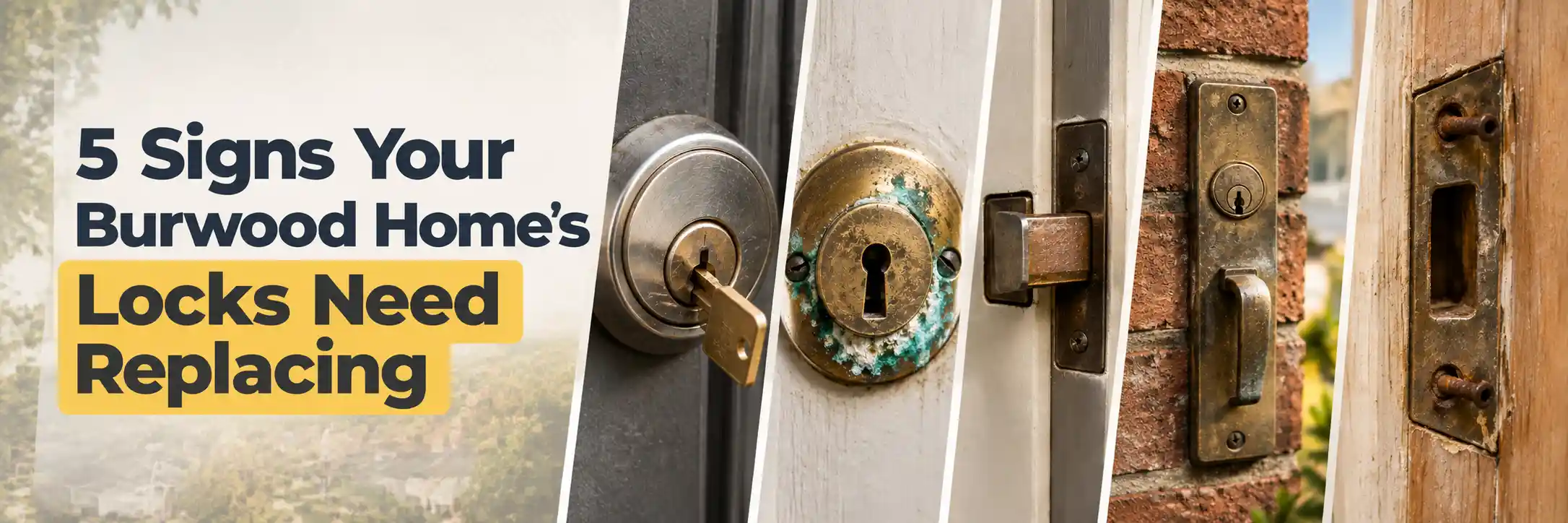
A lock that’s failing doesn’t usually announce itself clearly. It sends signals — subtle at first, then increasingly obvious — that most people rationalise rather than act on.
The key that needs a particular angle, the deadbolt that requires a second push, the handle that feels looser than it used to. In Burwood’s housing mix — the newer apartment towers, the Victorian-era unit blocks, the older residential houses on the suburb’s quieter streets — signs locks need replacing Burwood residents often ignore can be read accurately before the lock fails outright rather than after. Here are the five that matter most.
Sign 1: The Key Requires Technique to Operate
The clearest early signal of a lock approaching failure: the key no longer operates the lock with a smooth, single turn. Instead, it requires specific manipulation — lifting slightly while turning, pushing the door simultaneously, inserting at a particular angle, or jiggling until the mechanism catches.
The technique becomes habitual so quickly that many residents don’t register it as a problem. They’ve simply learned how their lock works.
What’s actually happening: the cylinder’s internal components — pins, springs, the plug that rotates when the correct key lifts them — have worn or corroded to the point where the key’s cuts no longer cleanly align the pins. The mechanism still works under the right conditions, but those conditions are narrowing. Under stress — a broken key, a wet lock, a hurried attempt in the dark — the technique that works in normal conditions stops working.
The test: insert the key and turn it with a normal, relaxed motion. No technique. If it doesn’t operate cleanly, the mechanism is telling you something.
What to do: have the mechanism assessed. Sometimes a service — cleaning, lubrication, pin inspection — restores function. Often, in Burwood’s older housing stock, the wear is past the service threshold and cylinder replacement is the correct outcome.
Sign 2: Visible Rust, Corrosion, or Physical Damage
External lock hardware in Burwood’s residential buildings is exposed to the elements year-round. While Burwood’s inland location means it doesn’t face the salt air corrosion of harbour suburbs, the suburb’s climate — warm summers, winter rain, the humidity cycles of urban Sydney — produces corrosion on external hardware over time.
The visible signs that warrant assessment:
- Rust on steel components — strike plates, hinge pins, the bolt face. Surface rust that wipes off is cosmetic; rust that’s penetrated the surface and pits the metal is structural.
- Green or white deposits on brass hardware — the characteristic oxidation of brass exposed to moisture without maintenance. Surface oxidation on the escutcheon plate is cosmetic; deposits in or around the key-way indicate internal moisture penetration.
- Paint or filler covering damaged areas — a previous occupant’s cosmetic fix for hardware damage. Paint in a key-way or over a strike plate screw is a sign that maintenance has been deferred rather than performed.
- Physical damage to the cylinder face or deadbolt — scratches around the key-way indicating picking attempts, tool marks on the deadbolt face, or a cylinder that’s visibly shifted in its mounting all warrant immediate professional assessment.
Pro Tip:
Look at your Burwood property’s lock hardware in direct morning light — the angle of morning sun reveals surface corrosion, scratches, and physical damage that flat overhead lighting misses. Move around the entry point and look at the hardware from different angles. What’s visible in these conditions tells you significantly more about the hardware’s actual condition than a quick straight-on look in standard lighting.
Sign 3: The Deadbolt Doesn’t Throw Fully or Smoothly
The deadbolt is the primary security mechanism on any residential entry in Burwood. Its job is to throw fully — extending completely into the strike plate recess — and retract smoothly when the key or inside turn is used. Either failure is a security gap.
A deadbolt that doesn’t throw fully may be:
- Misaligned with the strike plate — the bolt is hitting the strike plate frame rather than passing through the opening cleanly
- Worn to the point where the mechanism doesn’t generate enough force to throw the bolt to full extension
- Corroded internally, with the bolt movement impeded by accumulated corrosion products on the bolt’s guide surfaces
- In Burwood’s older housing stock: operated by an original mechanism with worn springs that can no longer drive the bolt consistently
A deadbolt that doesn’t retract smoothly is a lockout risk. It also indicates wear or corrosion in the retraction mechanism that will worsen over time.
The test: with the door open, operate the deadbolt through its full cycle with the key or inside turn. It should throw and retract with normal effort, reaching full extension on throw and retracting completely. Any resistance, partial throw, or grinding indicates a mechanism that needs assessment.
Sign 4: The Lock Has Never Been Changed Since You Moved In
This is a sign not of mechanical failure but of security exposure — and it’s the most common situation in Burwood’s active rental market and owner-occupier housing stock.
A lock that’s never been changed since you moved in is operating with a key history that predates your occupancy. In Burwood’s apartment buildings, this history includes the previous tenants and everyone who held keys during their occupancy. In Burwood’s older residential houses, it may extend across multiple ownership periods and renovation projects over decades.
The relevant question isn’t whether the previous occupants were trustworthy. It’s whether every key in their network has been accounted for and returned. In practice, this is almost never possible to confirm fully. A lock that’s never been rekeyed is a lock whose key history is unknown — and unknown key histories, in a dense Inner West suburb, represent a specific and addressable security exposure.
Signs this applies to your Burwood property:
- You moved in and the property manager handed over keys without mentioning rekeying
- You purchased the property and didn’t arrange rekeying on settlement day
- You’ve been in the property for more than a year and the only key changes have been additional copies cut — not a cylinder change
- You can’t state with confidence how many working copies of your door key exist and who holds each one
Sign 5: The Lock Is Original to a Building More Than Ten Years Old
Burwood’s housing stock spans a significant age range — from the newer CBD precinct towers completed in the last five years to the Victorian-era apartment blocks that have been in the suburb for decades. Lock hardware ages, and the timeline from installation to meaningful degradation is shorter than most residents assume.
Australian Standards for residential lock hardware (AS 4145.2) define security ratings that the locks installed in older Burwood buildings may not meet — not because the locks are defective, but because they were manufactured and installed before current security standards were established. A lock from a building’s 2005 fit-out is not meeting 2025 security standards, regardless of how well it’s been maintained.
Additionally, a lock that’s been in active daily use for ten or more years has experienced thousands of key cycles. High-quality residential hardware is rated for 250,000 cycles; budget hardware for fewer. In Burwood’s rental stock — where active daily use across multiple tenancy periods is the norm — older locks may have approached or exceeded their rated service life without any obvious functional failure.
“The calls that come in about failed locks in Burwood are almost always from people who noticed the signs earlier but didn’t act on them. The key that needed technique for the last six months. The deadbolt that didn’t throw fully. The building that was renovated twelve years ago and has the original hardware. When we ask how long they’d noticed the issue, the answer is usually months. The lock failure itself was a few seconds.”
When to Repair vs Replace
Not every lock showing these signs needs full replacement. The assessment that determines the right response:
- Technique required for key operation: assess the cylinder condition. If cleaning and lubrication restore normal operation and the mechanism is otherwise sound, service may be sufficient. If wear is significant, cylinder replacement is the correct outcome.
- Visible corrosion: surface cosmetic corrosion on external hardware doesn’t require replacement; structural corrosion that’s compromised the mechanism does.
- Deadbolt not throwing fully: assess whether the issue is door/frame alignment (adjustable without replacing the lock), mechanism wear (may be serviceable), or corrosion (cylinder replacement typically required).
- Never been changed since move-in: rekeying the cylinder closes the key history without replacing the hardware — appropriate when the mechanism is in good condition. Full cylinder replacement is warranted when rekeying is combined with an upgrade in security specification.
- Original hardware more than ten years old: cylinder replacement with a current-specification high-security cylinder is usually the right outcome — rekeying a worn, below-specification cylinder restores key history control but not security performance.
Warning:
If your Burwood property’s lock shows Sign 3 (deadbolt not throwing fully) and you’re planning to delay assessment: the half-thrown deadbolt is your primary entry’s security mechanism operating at reduced effectiveness. A bolt that extends only 15mm into the strike plate rather than the standard 25mm requires proportionally less pry force to clear. This isn’t a cosmetic issue — it’s the difference between a locked door and a door that’s noticeably easier to force. Assess this one promptly.
The Burwood Assessment Sequence
- Test key operation with a normal, relaxed turn — no technique allowed
- Visually inspect all external hardware in direct morning light
- Test deadbolt throw and retraction with the door open
- Ask when the cylinder was last changed — if unknown or more than five years ago, add this to the assessment
- Check the age of the hardware against the building’s construction or last renovation date
Conclusion
Signs locks need replacing Burwood residents can identify don’t require technical knowledge — they require paying attention to information the lock is already communicating. A key that needs technique, a deadbolt that doesn’t throw fully, visible corrosion, an untracked key history, and original hardware in an older building are each individually actionable signals. Combined, they indicate a security situation worth addressing before the mechanism makes the decision for you.